Posted

The green and gold cover of Anne Winge’s Prinsesser og Trold.

Tl;dr: Some books of fairy tales give no return on the invested effort.

Anna Winge (1860–1921) was born in Christiania, the niece of the national poet Johan Sebastian Welhaven on her mother’s side. She studied music and song under Thorvald Lammers and Desirée Padilla, then worked as a singing teacher. She founded a choir, wrote an opera, published a hymn book, and generally did musicky stuff.

In 1901, she published Prinsesser og trold: eventyr for børn, a brief collection of fairy tales for children.

Ever on the lookout for a new translation project, I picked up a rather worn copy of Prinsesser og trold so that I might investigate these stories; would they entertain enough today to warrant translation and publication? I have consequently translated two of the tales, “The Lily Princess” and “The North Wind and the South Wind,” which are the first and fifth texts respectively. (I find that translation is the most effective method of deep-reading, as it forces me to properly understand what I am reading before formulating the same thought in a different language – no shortcuts.) And I discovered that these stories will just not cut it.

In “The Lilly Princess,” as an example, the plot does not hold together. We begin with a lovely description of a castle garden in which grows an apple tree that bears golden apples (real gold) that the children of the kingdom gather every autumn, much to their and the king’s delight. And that’s the last we hear of that.

Now, there is also a tarn at the bottom of the king’s park (in which lies his garden, in which stands his castle), where dwelt a troll, perhaps a hundred years ago. The troll stole away the princess of the day, and the king her father struggled to banish the troll at last. There is a description of the cross that king erected to ward off the troll’s return.

Well, the prince of the present has to go out to look for a wife, but just as he is about to set out on his quest, his mother falls very ill, and apparently, there is a single nightingale in all the kingdom that can save her life. How he heard of the nightingale is not related.

Off he goes to find the nightingale; a princess for a wife can wait.

Anyway, this nightingale, which of course the prince does find, causes him to weep a tear, which falls on to a lilly growing at the foot of a linden tree. The lily turns into the princess abducted by the troll. The nightingale itself is apparently a singer who has been been enchanted by enchanter unknown for a hundred years. At the end of the hundred years, she will turn back into a singer and become world famous. But we hear no more about this. They all go back to the castle, the nightingale sings the queen better, there is a wedding, and they all live happily ever after.

So the apple tree at the beginning and the nightingale at the end are both narrative dead ends. Add to this major turn off the language that does its best to imitate Hans Christian Andersen’s pathos (but falls short), and perhaps you’ll understand why I gave this brief collection a pass.

The other tale I translated, “The North Wind and the South Wind,” doesn’t have a plot at all.

Author
Categories Folktale, Norway

Posted

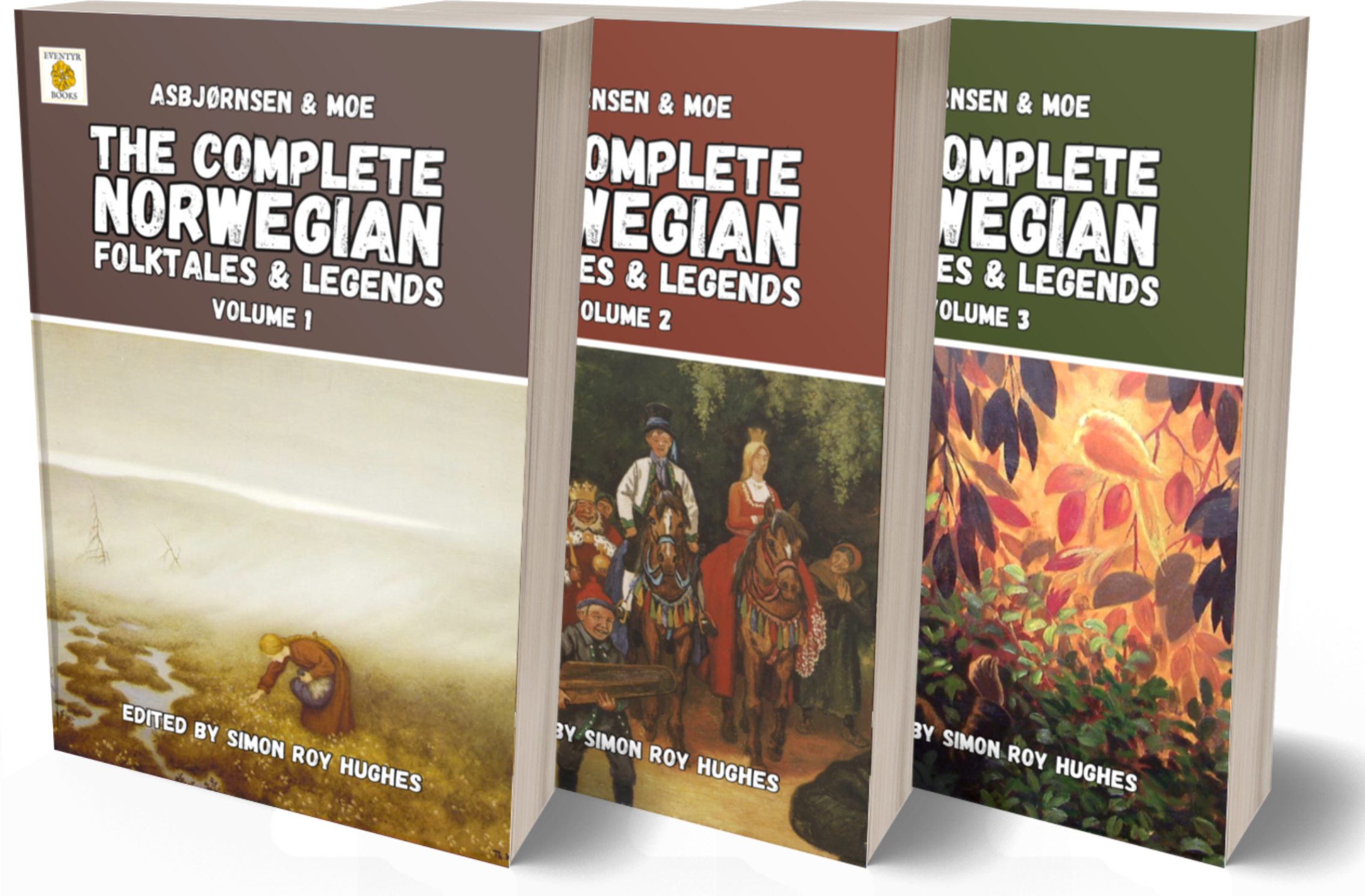
A mockup of the cover of Norwegian Folktales: Forgotten Variants.

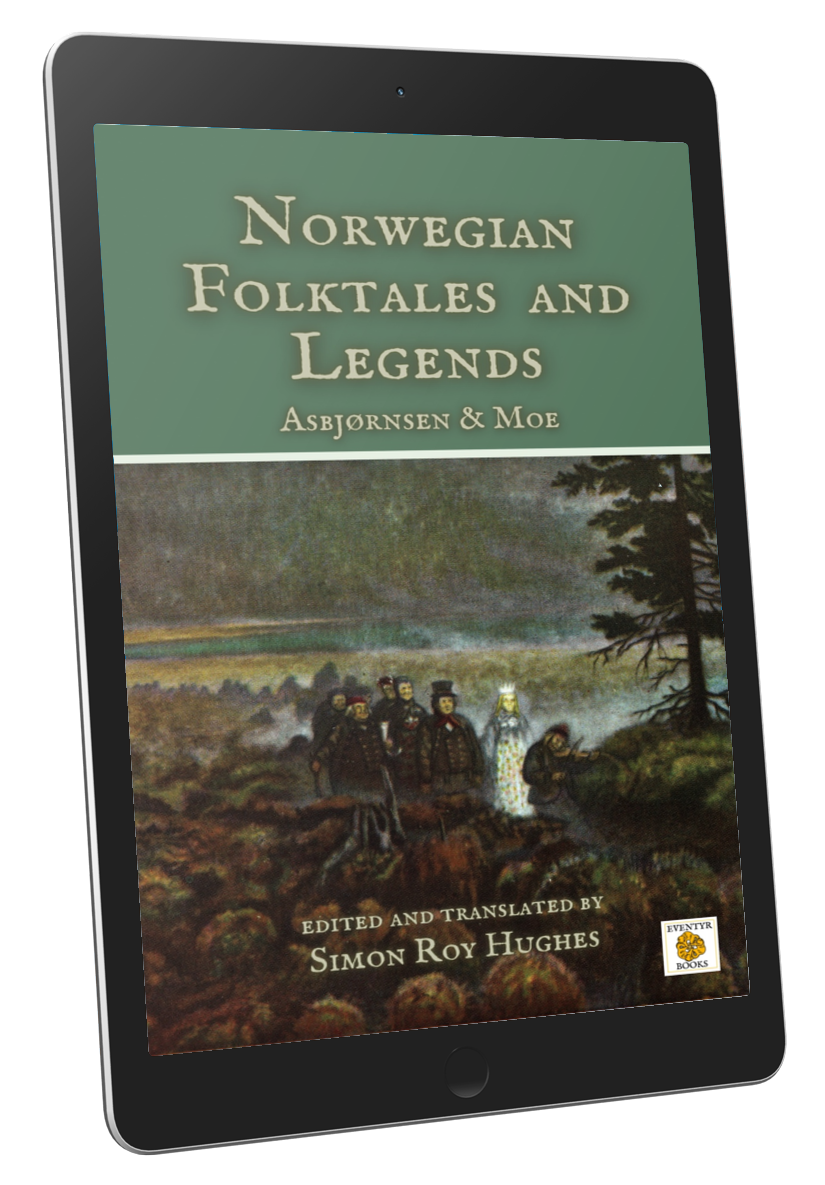
When Asbjørnsen & Moe went into the field, they recorded the folklore as well as they could, as their respective raconteurs told them their legends and tales. Not having voice recorders, the collectors relied on their ability to make notes of what they heard, for later recomposition into more or less polished narratives suitable for publication. As they collected, they repeatedly heard stories that resembled one another, and although they recorded them all, they chose to compose and publish only the strands of tradition that best suited their sensibilities. The other variants were relegated in note form to their records, to which they refer from time to time.

Outlines of some of these variants found their way into the notes appended to the second edition of the first collection of folktales (1852). Some were recovered later by other editors, and published – either in reconstituted form or as sketches – in the twelve-volume Norsk eventyrbibliotek (Norwegian Folktale Library, published between 1967 and 1981) or other, more minor editions.

Working on The Complete Norwegian Folktales and Legends of Asbjørnsen & Moe, I have come to appreciate how entertaining some of these alternative variants would have been, had they been written out in full and published. And then I thought: Why shouldn’t I have a go at doing just that?

A mockup of the cover of Norwegian Folktales: Forgotten Variants.

My first foray into writing – reconstituting – folktales was “Sir Varivan,” a white bear/ East of the Sun type folktale I published in my Five Norwegian White Bear Tales in 2019. It was fun to do; and having immersed myself in the language of the folktale – the eventyrstil – for so long, I found the idiom came quite easily. So I have continued to work on them, from time to time. There will soon be enough to fill a volume of stories, which I will publish in due course.

So what is different about these tales? Well, how about a variant of the billy-goats and the troll under the bridge in which the confrontation takes place as the goats return home in the late summer, having already eaten their fill? It makes much more sense that way. How about a tale of “Faithful and Unfaithful,” where the talking animals accuse a squirrel who lives in the tree of telling their secrets? This one brings to mind the squirrel Ratatoskr, which lives in Yggdrasil. A variant of “Grim Buckskin” called “ Bucephalus”? A mashup of “The Three Princesses in Hvittenland,” “The Swan Maidens,” and “The Seventh Father of the House”? Or how about a confusing tale with the remarkable title, “The Princess Who Should Commit Fornication and Murder” in which the moral character of the stepmother is ambiguous? Exciting stuff, indeed!

As ever, watch this space. The book is forthcoming.

Author
Categories Folktale, Norway

Posted

I have finished writing the introductions, and there is now nothing left for me to do but edit a few incidental texts before publication. I hope this editing will be done before summer commences, and I am hoping to publish before the beginning of autumn.

What a wild ride it’s been!

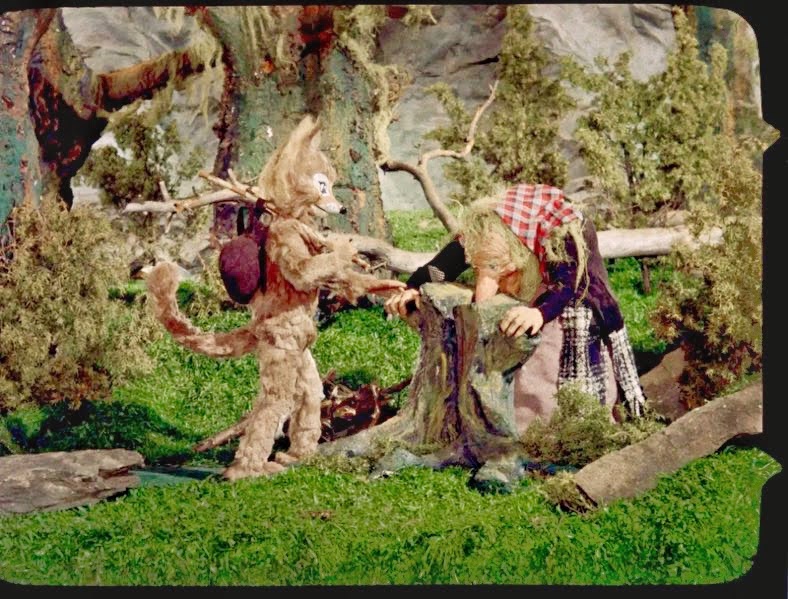
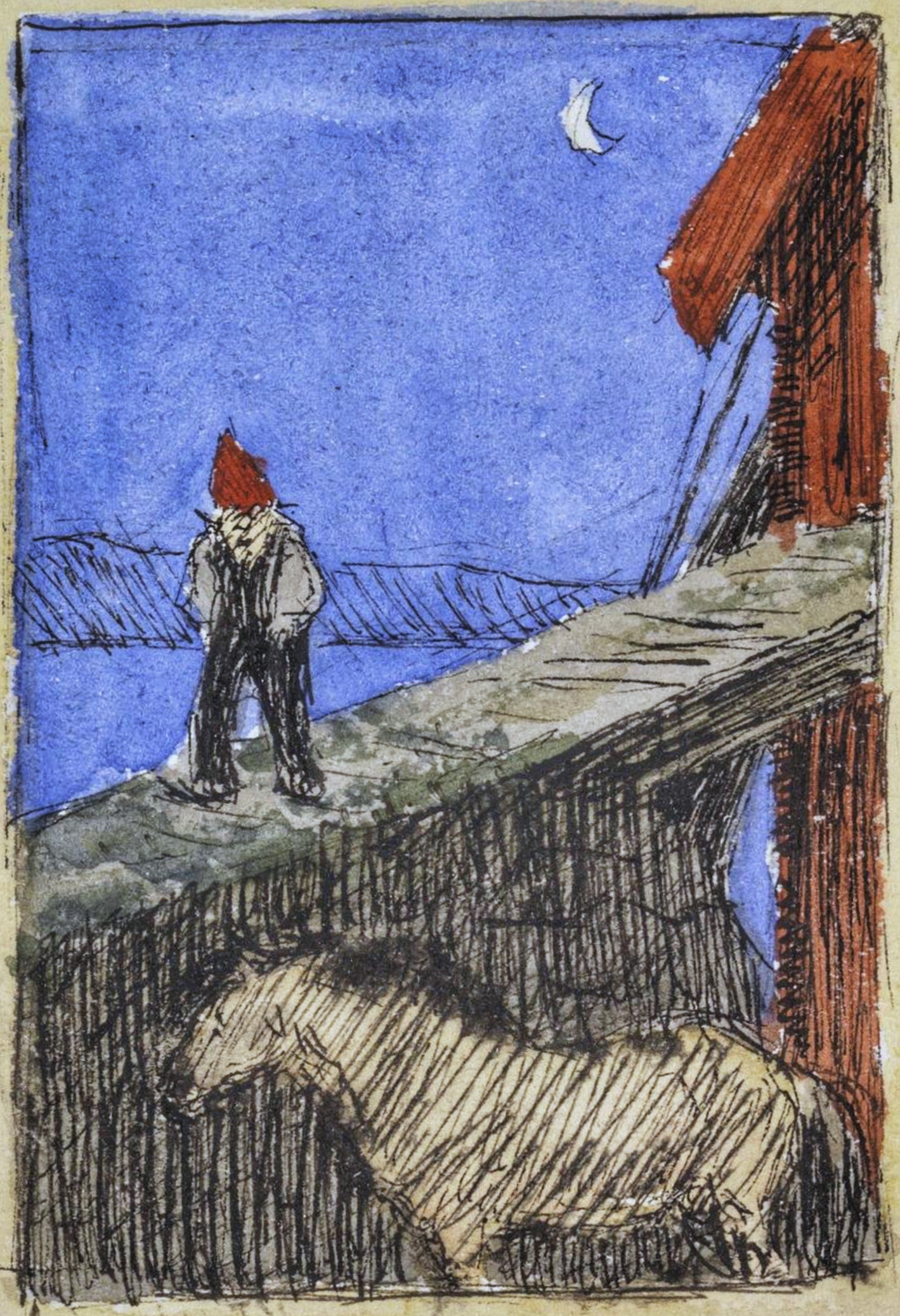
Even for a Londoner, Norwegian folktales have been part of my life for as long as I can remember. At home, Vera Southgate’s “The Three Billy Goats Gruff” from 1968 was my first introduction. Robert Lumley’s illustration of the troll climbing on to the bridge (shown left) is forever etched into my psyche. I have vague recollections from school, of puppet films that include characters eating what appeared to be wallpaper paste, but which was called porridge; I had never seen porridge like that. Funnily enough, I can date these recollections, for I only attended that particular infants’ school for a year, so it must have been 1976. (The huge Betamax video player in the audio/ visual room also made an impression.)

Fifteen years later, I saw these films again, this time at an exhibition of Ivo Caprino’s work in Bergen, Norway. It was at this exhibition that I was at last made aware of the Asbjørnsen and Moe collection. I wanted to read it all.

Another ten years passed. I had by this time fathered three children, and taken far too much education. I was looking around for something to occupy my mind while I worked a part-time job and weighed the pros and cons of embarking on an academic career. It was my tenth year of living, studying, and working in Norway, and I wondered if I was competent enough to translate something from Norwegian to English. I decided a short trial would suffice, and had a go at one of Asbjørnsen’s folktales: “Bamse Brakar,” which I called “Goodman Bear.” I found the work satisfying, and translated a further handful of tales. Then I discovered that the whole collection had never appeared in English. And I realised I could remedy that situation.

The rest is really history, except that life intervened for another ten years, and it wasn’t until 2015 that I seriously attempted to complete the collection, with the support of the fine folk of #FolkloreThursday to cheer me on.

That was all half a million words ago, now.

Author
Categories Publishing, Misc.

Posted

lmarinen Ploughs a Field of Vipers. Akseli Gallen-Kallela  (1865–1931).

Ilmarinen the Blacksmith never grew tired of hammering.1 One day, as he was putting some iron in the forge, a maiden came to his smithy. She stood upon the threshold and called out to the Blacksmith: “If you knew what I have to tell you, Ilmarinen the Blacksmith, you’d not put that iron in your forge.”

“If you have something good to tell me,” he said, “then I’ll give you a beautiful piece of jewellery, but if it’s something bad, then I’ll drop this piece of red-hot iron right down your gullet.”

“There are two men out rowing in their boats; they are suitors to fair Catherine, the King of Hiisi’s daughter,” said the maiden.2 Ilmarinen the Smith took the iron out of the forge, fell into contemplation, and went home.

“Mother,” he said, “make the copper sauna hotter than glowing stone, and give me a fine shirt and a smart set of clothes.” Then Ilmarinen the Smith went out to bathe in the sauna, and returned home – and he had no belt around his hips and no shoes upon his feet.

“Brother,” he said, “take my swiftest three-year-old foal and with the copper harness and the pewter breastplate, fasten it to the golden sleigh with the iron runners and the steel shafts.” His brother did so, but he couldn’t fasten the breastplate. So Ilmarinen the Smith himself went out and fastened the breastplate – and he had no belt around his hips and no shoes upon his feet.

Then Ilmarinen the Smith sat in the golden sleigh with the iron runners and the steel shafts, and drove his foal with the copper harness and the pewter breastplate across the wild lake as swiftly as it would go; he drove as swiftly as the wind, and the horse’s hoofs did not get wet and no track of the sleigh appeared upon the water. He caught up with the two who were rowing, each in his own boat.

Catherine, the King of Hiisi’s daughter, stood in the window – as white and as pale and as fair as could be – looking out over the lake. “Father,” she said, “three suitors approach – two are rowing boats; the third rides across the lake in a golden sleigh.”

The King of Hiisi received them and gave them food and drink; they declared their intention – they had come to court fair Catherine. The King of Hiisi replied: “Indeed. Which of you can plough my worm meadow, bare of foot and unbelted around the waist?”

“I can,” said Ilmarinen the Blacksmith. The others bowed and went on their way, but Ilmarinen the Blacksmith harnessed his strong, spirited foal to the plough and set about ploughing.

The worms writhed two cubits deep in the meadow; they hissed and squirmed around the plough and up over Ilmarinen himself, but they could do him no harm. He ploughed the worm meadow, and then he returned and bowed before the King of Hiisi.

“Now, can you get all the big fish in the lake to swim and the small fish to jump?” Ilmarinen the Smith went and did so, and then he returned and bowed before the King of Hiisi.

Now the King said: “Now go down to the shore of the lake and fetch fair Catherine’s bridal box.”

Ilmarinen the Smith went down to the shore of the lake, where sat three Maidens. “Good maidens,” he said, “tell me, where is fair Catherine’s bridal box?”

“Old Untamo has the chest,” replied the maidens.3 “There away, you can see where he dwells; many tracks lead thither, but few come thence.”

Ilmarinen went to Untamo’s dwelling. He was lying out in the field, and had dragged himself around the whole house so that his head and feet met at the door. Ilmarinen the Smith leapt through the door into the midst of the parlour. “You, old Untamo, bring me fair Catherine’s bridal box,” he said.

“I shall give it to you,” replied Untamo, “if you can step on to my tongue and dance there.”

Ilmarinen the Smith did so: he stepped on to his tongue and jumped and danced about. Old Untamo gaped a cubit and a half, and showed his teeth, which were a cubit long, and swallowed Ilmarinen the Smith whole, down into his belly, without a bite.

Once Ilmarinen the Smith was there, he took off his shirt and fashioned it into a forge. He fashioned bellows from his trousers. He used his left knee for an anvil, his left hand for tongs, and his right for a sledgehammer. He took the copper button from his shirt and forged from it a bird with iron claws and a steel beak. Then he sang a ballad that gave life to the bird. It fluttered around in old Untamo’s belly, tore at veins and tendons, and made a hole in his side.

Ilmarinen the Smith climbed out through the hole and returned to the maidens who were sitting by the beach. “Maidens,” said he, “give me fair Catherine’s bridal box.”

The maidens replied: “There away it lies in the sand; take it and go.”

Ilmarinen the Smith picked it up and took it back to the King of Hiisi, where he bowed and said: “Here is fair Catherine’s bridal box.”

Thus did Ilmarinen the Smith win fair Catherine, the King of Hiisi’s daughter.

Ilmarinen the Smith and his bride got into the golden sleigh with the iron runners and steel shafts, and drove his quick, spirited foal with the copper harness and the pewter breastplate across the wild lake as swiftly as it would go; he drove as swiftly as the wind, and the horse’s hoofs did not get wet and no track of the sleigh appeared upon the water. Ilmarinen the Smith drove on, and night fell. Then he sang a ballad so that an islet grew up in the midst of the lake. There Ilmarinen the Smith lay down to sleep beside his bride.

When he awoke in the morning, she was gone. He went and counted all the ducks that were around the islet, and there was one duck too many. So Ilmarinen the Smith sang a ballad: “Don’t hide, Catherine,” and then she returned.

He drove out onto the lake again. He drove and drove, and night fell. The Blacksmith again sang up an islet on the lake and lay down there with his bride.

When he awoke in the morning, she was gone again. He went and counted the trees on the islet, and there was one tree too many. “Don’t hide, Catherine,” said the Blacksmith to the tree. “There you are.” And he sang a ballad until she returned.

Then he drove out again with his bride. He drove and drove on the lake until night fell. Then he sang up an islet on the lake and lay down there to sleep with his bride, and in the morning when he awoke, she was gone again.

Ilmarinen the Smith went and counted all the stones on the islet, and there was one stone too many. “Don’t hide, Catherine. There you are,” said the Blacksmith, singing a ballad. Then Catherine returned.

“Catherine, I have suffered much on your account without fearing the worst. So now you must go and dwell upon the lake forever, and for your punishment you shall always have the wind against you.”

That’s what Ilmarinen the Smith said, after which he turned his bride into a herring gull.


  1. Ilmarinen the Smith is a mythical smith in Kalevala, the Finnish national epic. Among other feats, he is credited with taming iron and inventing smithing itself. See Runes XVIII–XXV of Kalevala

  2. Hiisi is a mythical realm of the trolls and giants. We can therefore assume that the King of Hiisi is a somewhat fearsome figure. 

  3. In Kalevala, Untamo is the god of dreams and the personification of indolence. 

Author
Categories Folklore, Finland

Posted

Peter Nicolai Arbo. Valkyrie, 1869

Over the last week or so, I have been translating the last of Asbjørnsen’s prefaces I had left (the preface to the 1859 second edition of the first volume of Norske Huldreeventyr og Folkesagn). I thought it would be a trivial job; it's just a preface, after all. This particular preface is >5000 words long, though; it has proven to be quite a job, and I wish I had tackled it earlier. That said, the text is very interesting, and goes a long way towards documenting the link from contemporary accounts of witches, to legends of the Asgårdsreie (the Norwegian edition of the Wild Hunt), to the valkyries of Old Norse and other Germanic literature, and back to the goddess Freya (who obviously liked cats).

I won’t pre-empt publication here; I shall be including the preface in my third volume, later this year. Something I can write about, though, is the artistic production of the Norwegian painter and illustrator Peter Nicolai Arbo (1831–1892), who appears to have understood Asbjørnsen’s argument. This understanding may be seen in his artistic production.

Arbo began with a maiden of the slain, the Valkyrie we see above, in 1869. He moved on to depicting the Asgårdsreie in 1872, a wild procession across the sky, driven at times by Guri Ryserova, at times by Odin or even Thor. These legends represent the crossover from earlier mythology to later folklore – the figures from the old religion being replaced as we move into the modern ages.

Peter Nicolai Arbo. Asgårdsreie, 1872

Lastly here, he illustrated some of Asbjørnsen’s legends, beginning in 1879. Below is Arbo’s portrayal of a legend embedded in the hulder tale and folk legend, “Legends from the Mill,” in which a tailor who spends the night in a sawmill is thronged by a flock of cats which turn out to be witches.

This short series of images, reproduced here in chronological order of production, also demonstrates the folkloric development of the valkyries into sky riders into witches. Asbjørnsen’s preface tells the story that the pictures cannot, however: the connection between the concepts.

Peter Nicolai Arbo. The cats in the sawmill, 1879

Author
Categories Folklore, Norway